

Written by Caitlin Johnson, RD – Registered Dietitian Contributo
If you've been searching for what foods increase GLP-1, here's the most important thing to know first: GLP-1 isn't found in food. It's a hormone — a peptide your body produces in response to eating. So the real question isn't which food contains the most GLP-1. It's which meals trigger your body to produce more of it naturally.
That distinction matters, because most of the content out there is getting this wrong. And if you're eating a smoothie bowl every morning wondering why you're hungry again by 9am, this is probably why.
Let's get into it.
Why Am I Still Hungry (Even If I'm Eating Healthy)?
Let's say it out loud: some of the "healthiest meals" we think of are the least satisfying ones.
Consider the classic smoothie or acai bowl. It looks incredible on paper — chia seeds, granola chunks, a drizzle of peanut butter. You eat it and feel like you have your life together, for about 7 full minutes. Before your coffee even has a chance to kick in, you're hungry again.
What about a salad? The classic "I am well-behaved today" salad. Lettuce, cucumbers, some carrot shreds. Very little protein and dressing on the side, because we are being disciplined now. You finish it and immediately start thinking about what else you can have without "ruining" your day.
Then there's the snack plate. Crackers, fruit, maybe a handful of pretzels and hummus. Technically balanced in the sense that it exists on a plate together. Functionally? It's just carbohydrates dressed in different outfits.
Here is the actual problem: none of these meals are doing much to turn on your fullness signals. And that is exactly what GLP-1 does.
GLP-1 stands for glucagon-like peptide-1 — and yes, there is more than one. GLP-2, for instance, has less to do with weight loss and more to do with promoting nutrient absorption and repairing the gut lining. There's also a peptide called GIP (glucose-dependent insulinotropic polypeptide), a 42-amino-acid hormone secreted by the small intestine that makes insulin more efficient and works as an appetite suppression booster alongside GLP-1. The key difference between tirzepatide and semaglutide is that tirzepatide targets both GLP-1 and GIP.
The good news: your body makes both of these hormones naturally when you eat well-balanced meals. When meals lean heavily on quick-digesting carbs, blood sugar spikes then crashes and your brain is already scanning the kitchen for its next target. This isn't a willpower issue. It's a meal structure issue.
When meals include protein, fiber, and fat alongside carbs — digestion slows, blood sugar stabilizes, and GLP-1 production increases. Hunger quiets down. It's the difference between a smoothie that leaves you hungry in 20 minutes and a meal that holds you over for 3–4 hours.
The 4 Nutrient Triggers That Actually Increase GLP-1 Secretion
Most articles on this topic will hand you a list of foods and send you on your way. But GLP-1 doesn't respond to lists — it responds to what your meal does once it hits your gut. So instead of memorizing random ingredients, here are the four types of nutrients that actually trigger your body's fullness signals. Once you understand these, you can build a satisfying meal out of pretty much anything in your fridge.
Fiber That Feeds Your Gut (Not Just Fills Your Plate)
Fiber is commonly thought of as the thing that keeps your gut moving. And yes — it increases the bulk of material in your intestines, giving them something to work with as they contract (a process called peristalsis) and move food through efficiently.
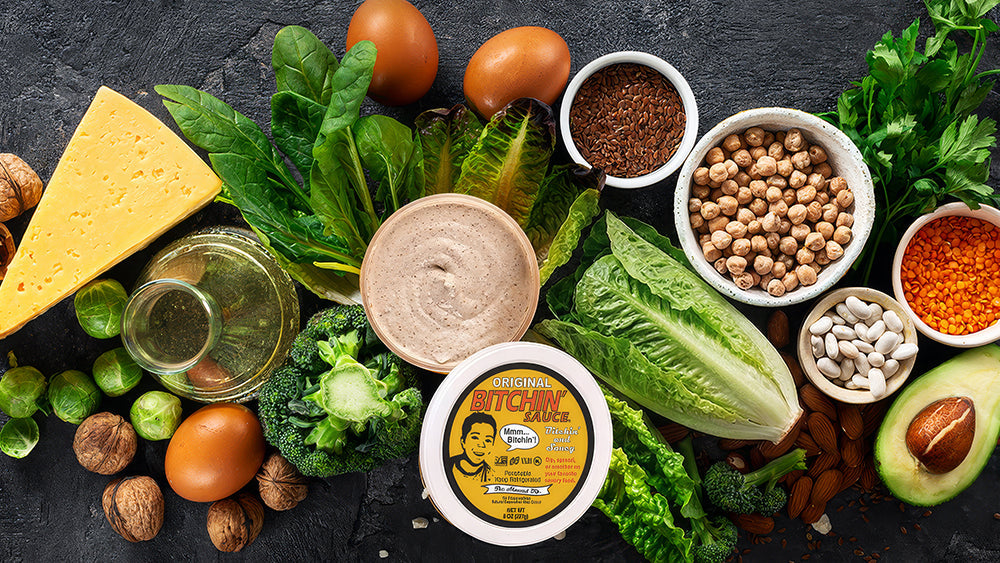
But it's not just about bulk. Fiber — especially from beans, lentils, vegetables, and oats — travels through your gut where bacteria get to work. These organisms ferment the fiber and convert it into short-chain fatty acids (SCFAs). Those SCFAs signal your intestinal cells to secrete GLP-1. And here's the part most people don't know: SCFAs are also the preferred energy source for those very cells.
Translation: fiber is literally feeding the system that tells your body you're full.
The challenge most people run into with high-fiber foods is that they can feel bland or repetitive on their own. Check out the best high-fiber snacks that use Bitchin' Sauce for practical ideas that make fiber-rich foods genuinely worth eating.
Protein That Signals "We're Good Here"
Protein is the body's version of a deep exhale. When you eat eggs, Greek yogurt, tofu, or legumes, your body sends a strong signal that says: we have what we need. Protein helps regulate appetite hormones, supports stable blood sugar, and plays a direct role in increasing GLP-1 production.
This is why meals without protein tend to feel like a warm-up to the actual meal. You can eat a full plate of carbs and still feel like something is missing — because biologically, something is.
A useful real-world illustration: on a long car ride, the amount of Pirate's Booty, popcorn, and snack gummies a kid can eat is impressive. But hand them a meat stick and a cheese stick first, and suddenly the car gets quiet. The protein signals to their gut that they're okay — no need to keep eating mindlessly. The same biology applies to adults.
Fats That Slow Everything Down (In a Good Way)
Fat has had a rough PR cycle since basically the early 2000s. But contrary to the prevailing narrative, healthy fat is one of your biggest allies when it comes to GLP-1.
Healthy fats — olive oil, avocados, nuts, seeds — slow down how quickly food leaves your stomach. This process is called gastric emptying, and when it slows down, GLP-1 production speeds up. A meal with healthy fat is the difference between something that passes through quickly and something that actually sticks with you.
This isn't license to go deep on fried foods. The conversation around moderation and overall diet quality still matters. But intentionally including healthy fat at meals is one of the simplest, most underrated levers you can pull to support natural fullness. Bitchin' Sauce is an almond-based healthy fat that works as a practical way to pull that lever across almost any meal — bowls, wraps, eggs, roasted veggies — without adding complexity.
Volume: The Physical Side of Fullness
Sometimes fullness is hormonal. Sometimes it's physical. Most of the time it's both.
Volume foods — vegetables and water-rich foods like cucumbers, zucchini, leafy greens, and fruit — take up space in your stomach. That physical stretch is one of the earliest signals your body uses to say: okay, we've had enough. Think Thanksgiving dinner, but without all the carbs and your aunt asking why you haven't had kids yet.
Volume works best when it's paired with protein and fat. A big bowl of lettuce isn't going to cut it. But add cottage cheese, avocado, quinoa, and Bitchin' Sauce? Now you've got something that activates both the mechanical and hormonal sides of fullness at the same time.
The Unexpected Struggle for People on GLP-1 Medications
We've all heard someone on a GLP-1 medication say that "the food noise just goes away." But there's something people aren't talking about as much: when that food noise quiets and appetite weakens, food stops sounding good — not in a peaceful, satisfied way. More like first-trimester-of-pregnancy food aversion energy.
Sure, eating less helps with weight loss. But here's what I tell my patients when they're on GLP-1 medications: you still have to eat enough protein and fiber. And that's harder than it sounds when nothing sounds appetizing.
Without enough protein, weight loss happens — but a significant portion of it will be muscle. That's bad weight loss. It tanks your metabolism and sets you up for rapid weight regain once you come off the medication.
Fiber becomes extra important too. When you eat less, food transit time slows. Constipation becomes a real issue, and if fiber intake drops alongside appetite, it compounds the problem significantly.
This is where having something that makes food more appealing quietly becomes one of the most practical tools in your kitchen. When food feels less like a chore, it's easier to hit your protein and fiber targets without needing complicated recipes or a new meal plan. The goal isn't just to eat less — it's to enjoy eating enough to actually support your body.
For more on how meal structure supports GLP-1 naturally, here's why Bitchin' Sauce is a weight-loss go-to for natural GLP-1 support.
GLP-1 Medications and Food Work Best Together
When you zoom out, supporting GLP-1 — whether naturally or with medication — isn't about chasing one perfect ingredient. It's about understanding how to build meals that work with your body's own fullness signals.
Fiber feeds your gut. Protein reassures your body. Fat slows things down. Volume makes it all feel real.
Put those four together consistently, and "why am I still hungry?" stops being the question.
Frequently Asked Questions: What Foods Increase GLP-1?
What foods increase GLP-1 naturally?
No single food contains GLP-1 — it's a hormone your body produces in response to eating. The meals that trigger the most GLP-1 production combine fiber, protein, healthy fat, and volume. Foods like lentils, eggs, avocado, Greek yogurt, and leafy greens all contribute to the nutrient triggers that signal your gut to release GLP-1.
Does protein increase GLP-1?
Yes. Protein is one of the strongest dietary triggers for GLP-1 secretion. Eating adequate protein at meals helps regulate appetite hormones, stabilize blood sugar, and directly stimulates GLP-1 production — which is why high-protein meals tend to keep you full significantly longer than carb-heavy ones.
Does fiber increase GLP-1?
Yes — and in a particularly interesting way. When gut bacteria ferment fiber, they produce short-chain fatty acids (SCFAs) that directly signal intestinal cells to release GLP-1. SCFAs are also the preferred energy source for those cells, meaning fiber is literally feeding the system responsible for your fullness signals.
What should I eat if I'm on a GLP-1 medication?
Prioritize protein and fiber even when your appetite is reduced. Without enough protein, weight loss can come from muscle rather than fat — which harms metabolism long-term. Without enough fiber, reduced food intake often leads to constipation. Focus on meals that pack both into manageable, appetizing portions rather than trying to overhaul your diet entirely.


